

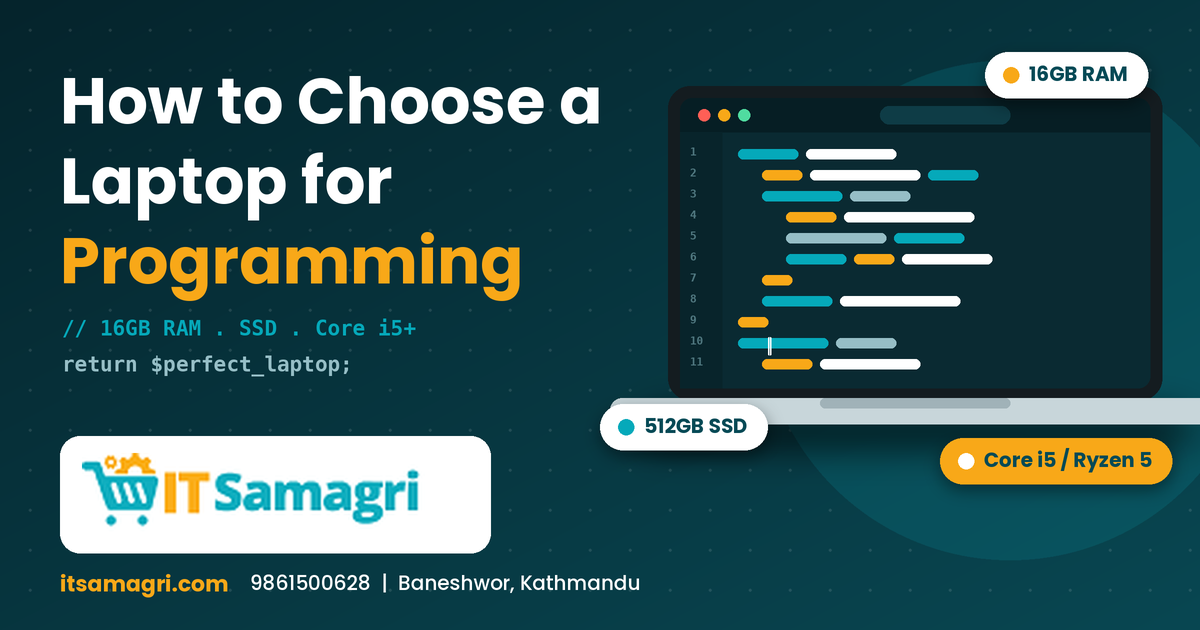
How to Choose a Laptop for Programming
Choosing the right laptop for programming is important for
writing code, running development tools, testing applications, and working
efficiently. A good programming laptop doesn't always need to be the most
expensive one—it needs the right balance of performance, storage, display,
battery life, and portability.
Here are the key things to consider.
1. Choose a Good Processor
The processor affects how quickly your development tools and
applications run.
For most programming work, a modern Intel Core i5 or AMD
Ryzen 5 is a good starting point. If you work with large projects, virtual
machines, Android development, or other demanding workloads, consider a
higher-performance processor.
2. Get Enough RAM
Programming often involves running an IDE, browser, database,
local server, Docker, and other tools at the same time.
- 8GB: Suitable for basic programming
- 16GB: Recommended for most developers
- 32GB+: Useful for heavy development,
virtual machines, containers, and large projects
For long-term use, 16GB RAM is a practical choice for
many programmers.
3. Choose an SSD
An SSD makes the laptop feel much faster when booting the
operating system, opening an IDE, installing dependencies, and working with
projects.
A 512GB SSD is a good starting point for most
developers. If you work with many projects, virtual machines, Docker images, or
large files, consider 1TB or more.
4. Check the Display and Keyboard
Programmers spend many hours looking at their screens and
typing code. A comfortable keyboard and a good-quality display can make a
noticeable difference.
A Full HD or higher-resolution display with good
viewing angles is generally a practical choice.
5. Consider Battery Life and Portability
If you frequently work from different locations, choose a
laptop with good battery life and a comfortable weight.
For developers who mainly work at an office or desk,
performance and upgradeability may be more important than having an ultra-light
laptop.
6. Check Operating System Compatibility
Choose an operating system based on the technologies you plan
to use.
Windows: Suitable for .NET, web development, programming tools, and general
development.
macOS: Popular for Apple development and also supports many web and software
development tools.
Linux: Excellent for developers who prefer a flexible, Unix-like development
environment.
7. Think About Future Requirements
Don't choose a laptop only for today's projects. If possible,
choose a model with enough RAM and storage for future development needs.
Quick Specification Guide
|
Requirement |
Recommended Starting Point |
|
Processor |
Core i5 / Ryzen 5 or better |
|
RAM |
16GB |
|
Storage |
512GB SSD |
|
Display |
Full HD or better |
|
Graphics |
Integrated graphics for most programming |
|
OS |
Windows, macOS, or Linux based on your work |
Final Thoughts
The right programming laptop depends on the type of
development you do. For web development, software development, and general
coding, a laptop with 16GB RAM, a modern Core i5/Ryzen 5 or better
processor, and a 512GB SSD can provide a strong foundation.
If you work with Android Studio, Docker, virtual machines,
game development, AI/ML, or other demanding workloads, consider higher
specifications.
Looking for a Laptop for Programming?
Need help choosing a laptop for web development, software
development, programming, or professional IT work?
📞 Contact: 9861500628
📍 Location: Baneshwor, Buddhanagar, Kathmandu,
Nepal
🌐 Website: itsamagri.com
Choose the right laptop and make your coding experience
faster, smoother, and more productive.